I thought about this in a different context many years back. A friend lent me a GP2X, a Linux based handheld game console. I already had a Nintendo DS, with one of those homebrew cartridges (which I used for the officially advertised purposes, rather than the wink-wink-nudge-nudge purposes). That got me to thinking whether locked down platforms were okay, that they may actually provide opportunities for developers of open systems.
The problem is that history has proven time and time again that it doesn't. While the homebrew scene for the DS was vibrant, even with the barriers, it was lacklustre on the GP2X, even without the barriers. There were likely a lot of reasons for that, but they all pretty much add up to the idea that not buying locked down products will not help.
I agree that you should have the ability to remove AI features, but that isn't the direction Apple has followed for the past decade or so. There's a lot of stuff in macOS that one should be able to remove, or at least disable, if one isn't interested in living within the Apple ecosystem.
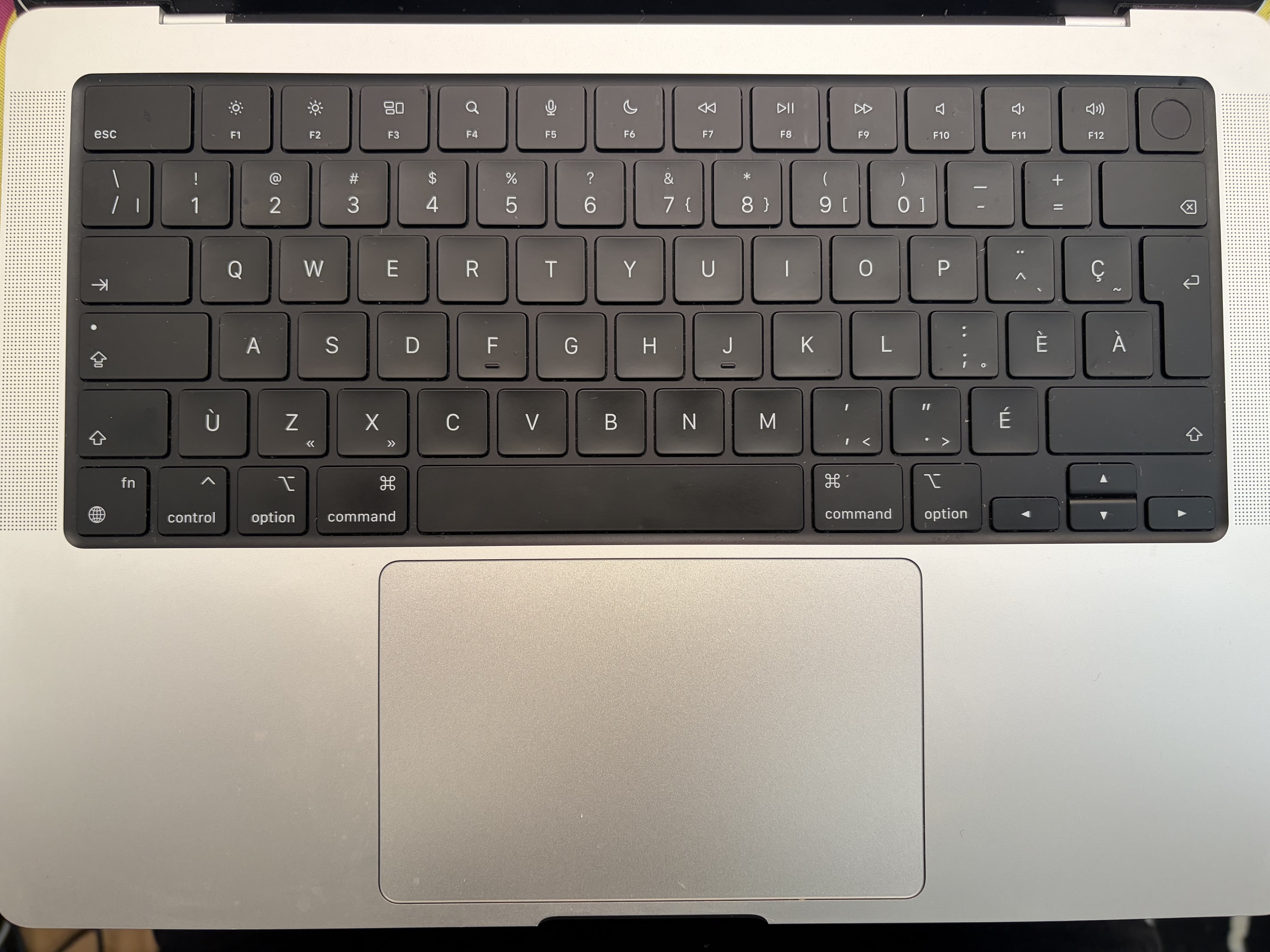
I'm wondering where those Canadian keyboards are used. I live in Canada, have seen plenty of multilingual keyboards, and have seen those symbols perhaps once. Even so I can't be sure it was on a keyboard. I just recognized one of the symbols.
Somewhat related: I live in France but have learnt computing on a QWERTY US keyboard back in the days, not AZERTY. As a result the only keyboard layout I can use without losing my sanity is a QWERTY US MacBook with a Canadian layout - I have my Q right where I want it, Enter key is lined up in the middle row, # $ % * are there for coding, and all the accents é è à ^ ç are there too. Thank you, Canada.
I bought my MBP in Québec, with the default keyboard they stock.
https://f.toi.sh/fr-ca-mbp.jpg (Pardon the dust!! You never really look too closely as your keyboard until you have to take a picture of it eh?)
Tab, capslock, shift, backspace, and return are all symbols-only. I feel like I have a pretty good ambient understanding of what they mean at a glance so I think I've always seen them on fr-CA layouts I've used.
Was trying to communicate to a designer in Ontario a while ago that we could use the backspace symbol for a correction key in a PIN entry view. We were working on an iOS application so I was immediately thinking that the apple default UI font would have exactly that "chevron with a cross" symbol styled how it looks on the keyboard somewhere in it. Designer was pretty confused about it though, so I think it's probably just fr-CA keyboards.
I don't think I've seen a French-Canadian keyboard before, that is so much less cursed than the AZERTY monstrosity I have from France (hold shift to type numbers! hold shift to type period and comma!)
I worked at the provincial government as an intern. We had those keyboards.
I'm willing to bet that more than 99% of the Canadian Multilingual CSA keyboards on PCs are used by public servants. There is another (French Canadian)layout that is much more common among consumers.
Of course, the Mac side is different, having somehow chosen to align with the (IMO superior) CSA layout.
> I worked at the provincial government as an intern. We had those keyboards.
Which province? Because I've never seen the CSA keyboard used here in Alberta, but it's also not terribly surprising that the Albertan government has poor support for French.
Perhaps, but I really don't know why a French keyboard would be different in Quebec compared to a French keyboard in the rest of Canada. There is a picture of a MacBook keyboard from another poster in this thread, which is what I would expect.
Probably the stores in english canada mostly just sell english keyboards (after all you can change the keymapping in OS). Maybe it would be different in a city that is 50-50, but if you are in a city that is 90-10 english, probably not a lot of people are stocking french keyboards.
I have picked up a couple laptops with French Canadian layouts over the years and have encountered said layouts in French immersion schools, so I'm no stranger to them. That said, I'm not a French speaker, so I never looked into variations.
ASCII is a 7-bit code, so there are only so many symbols one can add. Prior to ASCII, you had codes that used as few as 5 bits. Early C had the option to use digraphs to represent various forms of parenthesis, simply because symbols like {} and [] were not universal.
(Strictly speaking, people did continue adding symbols. We used to talk about code pages: when the MSB was 0, the other 7 bits were ASCII. When the MSB was 1, the other 7 bits were a user selected code pade.)
I am going to agree, albeit from an entirely different perspective.
My job has nothing to do with programming. Aside from administrative tasks, my job has nothing to do with computers. Yet I know how to program and I realize that automating those administrative tasks will have huge benefits for me. The problem is my employer doesn't pay me to write code, so I never got around to that automation.
Realistically speaking, writing that code without AI would not offer much in the way of understanding or expertise. Most of it is: "look up X, if A then B, else C, iterate" type tasks. There is a barrier in knowledge with respect to library calls, but that's pretty close to junk knowledge (it's rapidly obsoleted, and useless if I need to interface with different software).
So the choice is between doing without, or spending a lot of time picking up tasks that are of no value to me. Time was the barrier.
These arguments also remind me a lot of the microcomputer revolution: a heck of a lot of mainframe COBOL and FORTRAN developers were critical of underpowered computers and toy programming languages. The reality is that it opened up opportunities for a new generation of developers, and new types of software was created because the problem solvers were closer to the problem.
It is sad to see Firefox riding various hype trains over the years, but I can't really blame them. Miss the wrong train, and you fall behind and may not be able to catch up. Miss the train to nowhere, and you are only wasting resources.
As for the excellent browser that people want, that raises the question of what people want. There are likely as many answers as people.
There is a weird standard Mozilla is held to that doesn't exist even for other privacy-minded companies.
There is also a layer of hypocrisy when people beg for Mozilla to generate greater revenue diversity, but then an immediate scoff whenever they try anything unrelated to Firefox -- where there is no money beyond search deals since Mozilla can't go down the Brave crypto route.
Yeah. It’s a tough balance to achieve but that’s the situation we’re in right now so Mozilla really ought to step up (and I totally wish they would).
My biggest pain point at the moment (entirely subjective mind you) is not even the AI nonsense, but how disjointed and alien the Firefox UX and general feel is to Apple platforms (what I use, at the moment). I don’t want Firefox to mirror Safari 1:1 but I do want the Firefox UI and UX to feel polished, well thought out and thoroughly in line with system HIG specs—given that I spend a lot of time in a browser, it shouldn’t feel like a stranger in a strange land amidst my other desktop applications.
Aggressive UI improvements would go a long way to restore some faith in the incandescent fox‘ mission—at least for me.
Behaving like a native application also has tradeoffs. If you're only working on one platform, then sure you will want it to behave like a native application. If you're working on multiple platforms, chances are that you're going to value consistency. And while macOS users prefer their UI, the same can be said of Linux and Windows users. Guess which one is going to win out there.
Maybe I'm not enough of an Apple fanboy but using work provided mac with firefox for 15 years I never noticed UI being disjointed from the system any more than Chrome.
Maybe you’re too preoccupied trying to discredit valid criticism as “fanboyism” to realise how important UI and UX are for products such as browsers.
Besides, Chrome itself is already an absolute mess of conflicting and downright distasteful UX choices and patterns. Firefox seems to be stuck in the past but Chrome seems to actively DESPISE being available on Mac.
Not only that, but general colours are system-like but offputtingly different (dark theme is different from Mac dark theme just enough to be unsettling). Spacing (padding, margins, etc) is uneven on a lot of options, toggles and fields. Swipe back/forth being a simple arrow on the corner of the screen instead of full page swipe (like Safari) in the year of our lord 2026 is a complete disgrace (yes, chrome does this too, yes chrome also sucks). Press CMD+F and just watch as a search bar that hasn’t been updated to modern visuals in about 20 years pops up at the bottom. Pretty much everything around Firefox feels like a random collection of Windows and Linux behavioural patterns mashed together like a digital Frankenstein monster.
And despite what many people here like to think: these things matter. UX improvements compound exponentially, and so do UX problems. Firefox has an opportunity here to be a first-class citizen on every OS it runs on. It has the opportunity to be the browser that respects your OS choices no matter what, but alas, Firefox seems rather content carrying its “ah yeah I remember using it back in ‘06” reputation.
Firefox is not a bad browser by any means, but it feels like Firefox is the browser equivalent of the “how do you do fellow kids” meme. An out-of-time experience pretending to blend in under the guise of “AI”.
Most of those are subjective details and vary from platform to platform. Fine adjustments for each platform isn't guaranteed to attract many people to Firefox either. After all, the UI/UX of Firefox is good even if it isn't excellent. Factors such as convenience (e.g. familiarity or being pre-installed) are likely bigger factors. That said, I will grant you that things like the visibility of the find bar is poor.
It is also worth noting that the macOS UI/UX isn't anywhere near perfect. It is a hodgepodge of design decisions that go back to the origin of OS X or, in a few cases, the origin of the Macintosh iitself. Padding and margins may help achieve visual balance, but it's Windows management paradigm is an absolute functional mess.
Your argument boils down to “but Mac’s HIG isn’t perfect and UX/UI criticism is nitpicking”. OP is right though, UI/UX matters and despite Mac’s HIG being a mess, it is the Mac’s mess and users expect a Mac-like mess, Firefox should not be taking things into its own hands either way.
Maybe I shouldn't have included that second paragraph, since that's not my point. The second paragraph was more of an expression of frustration with how elements of the Apple user base regard macOS as the pinnacle of user interfaces and how everyone places an extremely high importance upon even minor elements.
Then again: while I believe bad UI/UX is a thing, I don't think there is an ideal. Different people think in different terms, or have different preferences. Some forms of interaction are better in one domain than another. There are undoubtedly many other reasons.
As for Firefox taking things into their own hands, that's the developer's decision. I have already given two reasons why that may be the case (users may expect consistency across platforms, and it may require too much effort for too little return).
Unfortunately “being the same everywhere” only works if your application is distinctive enough in functionality that it can’t be anything else but itself. Firefox is just a browser. Safari is also a browser. Chrome is also a browser. And none of these apps are more important or relevant than the operating system they are working under.
If my OS says windows and tabs close on the left, then I expect every single app to be a good platform citizen and not make me relearn default controls just to operate simple functions. Windows and tabs close on the left. End of story.
I agree with most of what you are saying. That said: alcohol is also a controlled substance, rather than an illegal one. It is perfectly legal for the original person to serve it within the legal limit. They're saying that the liability goes too far when they are held accountable for another server at another establishment that serves beyond the legal limit afterwards. On that part, I will agree with them.
Like you, I abstain. Yet I do have to deal with bartenders, and I will say that some are responsible and some are not. (I have pissed off some fairly powerful people along with people who commerially produce alcohol, and ought to know better, that they cannot serve alcohol because they are unlicensed, uncertified, or uninsured.)
> Nobody wants to pay for what they use, so companies extract value in other ways and you can't complain about that if you're not willing to pay what it costs.
I'm likely old school here, but I never liked "paying for what I use" in the online world because it required revealing some personally identifying information (i.e. to make payment). My attitude is almost certainly irrelevant these days, with the scope of online tracking, sharing of data, and the near necessity of disclosing one's identity to sites other than one's ISP, but it was an attitude that was established in my mind nearly 30 years ago.
(I also don't trust the pay for privacy model. First of all, you can never assume that paying for something implies your data won't be sold. That was even true before the public Internet. Then, even with statements about privacy, you cannot assume that will be true in the future. If the company is sold, management changes, or the company decides the need/want additional revenues, that will change. And that assumes they don't use weasel words about what privacy means, or the ultimate "we reserve the right to changes this agreement at any time".)
Kagi support zero knowledge search through a Firefox extension and Mullvad supports zero knowledge VPN by putting cash in an envelope with your account ID written on the outside.
I mean, there’s more privacy protection on payment data than there is for email address and browsing habits.
Plus most companies just push out payment handling to stripe. So most websites have little idea who actually transacted with them to begin with (email dependent).
The page doesn't make what SPICE is for obvious, aside from linking to other pages, but they are not talking about the circuit simulation tool. (It appears to be some sort of tool for accessing desktops of virtual machines remotely.)
I have the impression that you could also use it for accessing desktops of real machines remotely, too, but that's only because I keep running into it when I'm looking for information about the real SPICE, a 50-year-old open-source program used to design every computer you've ever used and for which the IEEE awarded Donald Pedersen the Medal of Honor.


The problem is that history has proven time and time again that it doesn't. While the homebrew scene for the DS was vibrant, even with the barriers, it was lacklustre on the GP2X, even without the barriers. There were likely a lot of reasons for that, but they all pretty much add up to the idea that not buying locked down products will not help.
reply