Hacker Newsnew | past | comments | ask | show | jobs | submitlogin
Large stationary gravity wave in the atmosphere of Venus (nature.com)
123 points by bcaulfield on Jan 17, 2017 | hide | past | favorite | 27 comments


To be clear, this article is about gravity waves (https://en.wikipedia.org/wiki/Gravity_wave), or ripples at the interface of two media of different densities caused by gravity, such as waves on the ocean or ridges of clouds, not gravitational waves (https://en.wikipedia.org/wiki/Gravitational_wave), the propagating ripples in spacetime.


With the LIGO discoveries last year I thought about gravitational waves too. Having such a wave having effects visible with the naked eye would be huge. It would probably rip the planet apart.


Important distinction, +1 for linking to the wikipedia articles!


Confusing terminology. I say the scientific community should rename "gravity" waves to "buoyancy" waves, which is more specific and accurate.


Gravity waves aren't caused by gravity, they are in the direction of the gravitational force.


Sure they are. Some of the denser fluid is above the average level of the surface, and gravity pulls it back down again. That's what makes the wave.


Gravity is one of several forces that may act on what's going on, but the cause of the wave is the initial perturbation, which isn't gravity. Put another way, if I have a steady-state hydrostatic system, gravity waves won't just spring into existence. You need that initial push.

In this case, the initial push seems to be wind hitting a mountain and being forced up.


> gravity waves won't just spring into existence. You need that initial push.

The gravity wave that causes tides on Earth requires no such push, it's just straight up deformation of the oceans by Lunar and Solar gravity.

> In this case, the initial push seems to be wind hitting a mountain and being forced up.

Where did you get that from, the body of the article? It's not in the abstract, which only talks about gravitational effects.


You need the medium, gravity, and 'push' to get a wave. Calling them <medium>-wave, or 'push'-wave doesn't really tell you anything useful, so they're called gravity-waves. An alternative would have been buoyancy-wave, but apparently this didn't catch on (buoyancy and gravity are really two sides of the same coin, anyway).


Buoyancy is related to density, which is independent of gravity. Check: buoyancy can exist in a non-inertial reference frame provided acceleration in a "downward" direction.

Also, you don't need gravity to be the force being acted against in order to form a wave. You can get impact waves in water at 0g because of surface tension.

https://en.m.wikipedia.org/wiki/Buoyancy


It's really something that Akatsuki is doing amazing science after the trials and tribulations that satellite has been through. After failing orbital insertion around Venus, it went five years in heliocentric orbit to reposition itself for insertion around Venus again. The team ended up macguyvering its secondary attitude control jets[1] for a long burn (~20 min) that they weren't designed for, but it worked and allowed for a successful insertion--albeit in a non-ideal orbit with a 9 day period instead of the originally planned 1.25 days.

[1] https://spaceflightnow.com/2015/12/06/japanese-space-probe-t...


I think any space-related MacGuyvering should be termed Kerballing.


Seconded.


Fun fact: spiral galaxies' galactic arms are stationary waves. They don't spin like spokes on a wheel. Stars in the arms don't remain in them - every star traverses through the arms and the regions between them [1]. Indeed, correlations have been hypothesised between Earth's extinction events and our Sun's predicted passage through these arms [2].

[1] https://m.youtube.com/watch?v=c5Us-jonCLA

[2] https://arxiv.org/pdf/1309.4838.pdf


> thick clouds of sulfuric acid

Given how reactive sulfuric acid is, how does this concentration remain stable?


Consulting https://en.wikipedia.org/wiki/Atmosphere_of_Venus the atmosphere is mainly CO2 and molecular nitrogen, neither of which reacts with sulfuric acid. The clouds are at 10km and up, so they don't interact much with the surface, which has a tallest mountain peak of 11km.


"Reactive" depends on the environment.

E.g. sulfuric acid in a container made of glass does not do much and remains stable a long time.


Oxygen is one of the most corrosive gases. How do we remain stable? But reducing ourselves to ash...of Hydrogen.


How? Lack of activation energy.

And indeed, metabolism is basically catalyzed combustion.


> The planet Venus is covered by thick clouds of sulfuric acid that move westwards because the entire upper atmosphere rotates much faster than the planet itself.

How the hell?! I get that the length of a Venus day is really long (243 Earth days), but why would the wind be rotating in the same direction but faster?


And they're speeding up!

"Already travelling at super-hurricane speeds, winds on Venus...accelerated by an astonishing one-third" between 2006 and 2012 [1].

[1] http://www.abc.net.au/science/articles/2013/06/19/3784975.ht...


That's one of the questions that's interesting... there's no obvious reason.


as someone who isn't a scientist I found this link to be a bit easier to consume: http://gizmodo.com/an-enormous-atmospheric-anomaly-has-been-...


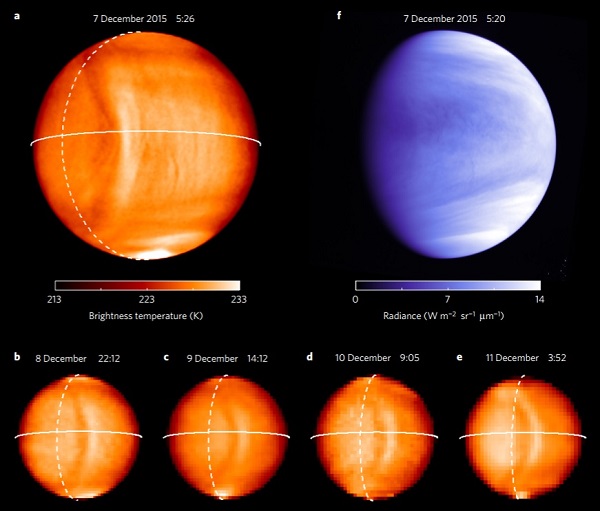
Here is a picture (I think) of this phenomena; it's much larger than I thought!


Did you forget to link to the picture?


No, it's just still very small

/joke


Guidelines | FAQ | Lists | API | Security | Legal | Apply to YC | Contact

Search: